

Commercial Air Source Heat Pumps
Engineering-Led Design, Installation, Servicing and System Optimisation
Commercial air source heat pumps can deliver significant reductions in energy use and carbon emissions, but only when the system is designed, operated and maintained around the building, not just the equipment.
At Plumbing & Gas Solutions (PGS), we support commercial organisations across the full lifecycle of air source heat pump systems. From early-stage feasibility and heat-loss assessments through to the servicing, optimisation and long-term maintenance of existing installations, we help ensure systems perform reliably in real-world conditions, not just on paper.
Understanding Commercial Air Source Heat Pumps
A commercial air source heat pump extracts energy from the outside air and transfers this energy in to heating and hot water within a building. Even at low external temperatures, modern systems can operate efficiently, often delivering up to four units of heat for every unit of electricity consumed.
Unlike traditional gas boilers, however, heat pumps operate at lower flow temperatures. This is where efficiency gains are achieved, but it also means heat pumps behave very differently within a commercial environment.
They are not a like-for-like boiler replacement and treating them as one is where many systems underperform.
Is an Air Source Heat Pump Right for Your Building?
Air source heat pumps are not suitable for every commercial property.
Factors such as available external space, building fabric, existing pipework, internal heat emitters and occupancy patterns all influence whether a heat pump will operate efficiently.
In some situations, a hybrid system or alternative heating solution may offer a better balance of performance, cost and disruption. Our role is to assess suitability objectively and advise on the most effective solution, whether that involves a new installation, adapting an existing system, or improving performance through optimisation and maintenance.
Why Commercial Heat Pump Design Is Different
With gas boilers, heat is generated internally at high temperatures and distributed through systems most buildings were originally designed to support. Heat pumps work differently: they rely on steady, low-temperature heat delivery and consistent operation.
As a result, the interaction between the heat pump, the building fabric and the internal heating system becomes critical. Whether we are designing a new system or reviewing an existing one, understanding this relationship in detail is essential to achieving reliable performance.
Typical Commercial Applications
Commercial air source heat pumps are commonly found in:
- Offices and business parks
- Industrial and warehouse facilities
- Educational buildings
- Public sector and local authority properties
- Commercial refurbishments and plant replacement projects
Each environment presents different challenges around heat loss, usage patterns and system layout. Systems that perform well in one setting may struggle in another if the design, installation or ongoing operation is not aligned with how the building is actually used.
Good To Know
External Space, Siting and Airflow
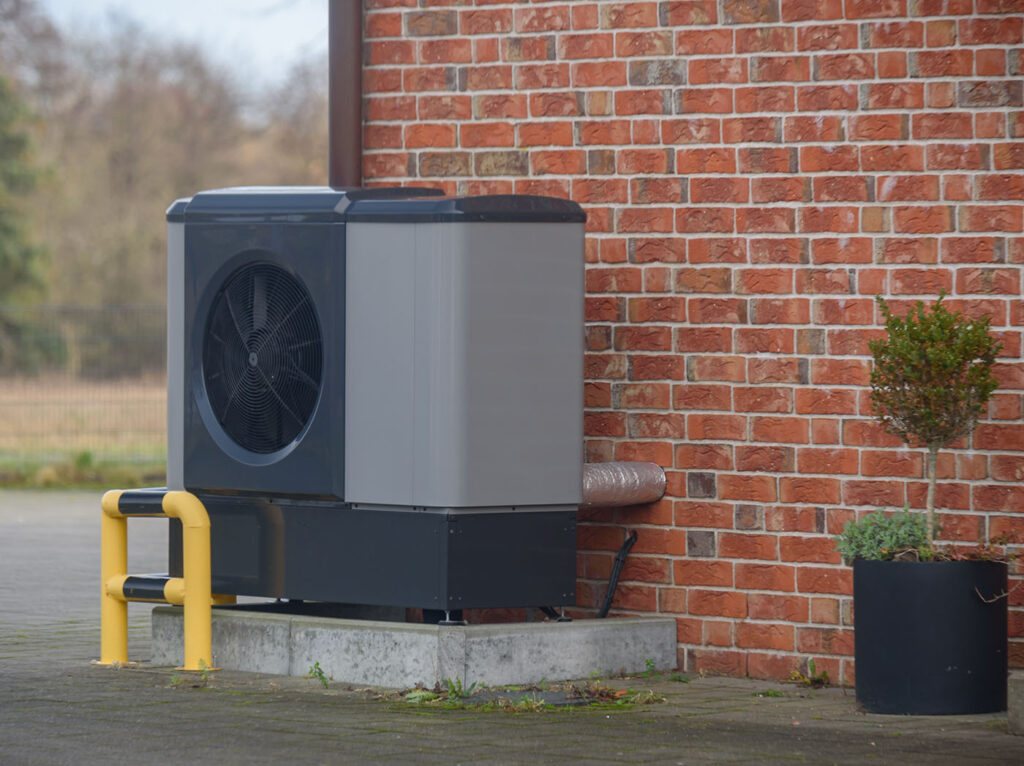
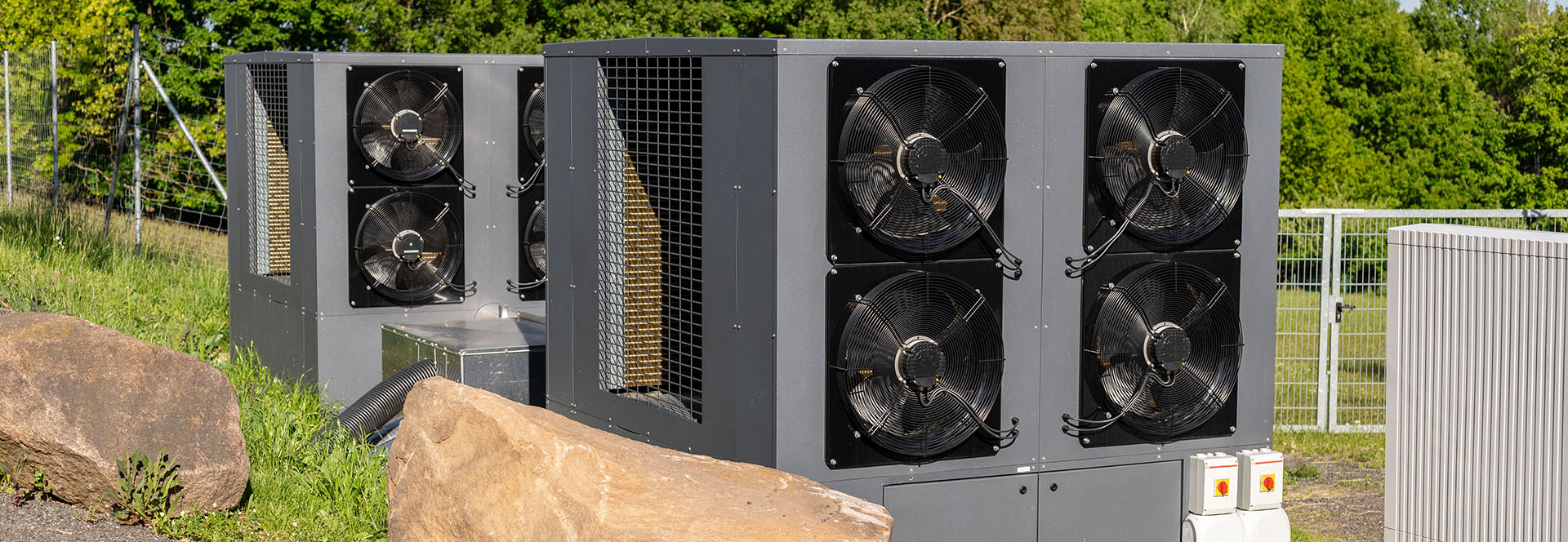
Commercial air source heat pumps are substantial external plant items.
For example, a 50kW unit may measure approximately 2m x 1.5m x 1m, with additional clearance required on all sides to maintain airflow.
Because heat pumps disperse cold air as part of their operation, poor siting or restricted airflow can significantly reduce efficiency. There are also regulatory requirements governing clearances and placement that must be considered early, particularly when systems are retrofitted or inherited.
Noise levels are generally modest, but not negligible, especially in commercial or mixed-use environments. Acoustic impact and proximity to occupied spaces must be assessed not only at installation, but over time as building use changes.
Lower Temperatures Change Everything Inside the Building
Heat pumps achieve efficiency by operating at lower temperatures than traditional gas boilers. While this reduces energy consumption, it has important implications for internal heating systems.
Many commercial buildings are fitted with radiators sized for high-temperature systems. When paired with a heat pump, these radiators may simply be too small to emit sufficient heat.
In practice, this often means:
- Radiators need to be significantly upsized
- Fan coil units or air handling systems are more appropriate
- Underfloor heating, where suitable, is an excellent match
Pipework also plays a critical role. Heat pump systems typically require larger pipe diameters to maintain adequate flow rates. In many existing buildings, legacy pipework can restrict performance unless it is assessed and upgraded as part of a wider system review.
What Happens When Heat Pumps Are Poorly Designed or Maintained
When design detail is overlooked or when systems are not properly maintained, the impact is felt quickly.
Poorly performing commercial heat pump systems often struggle to transfer heat effectively into the building. If the air source heat pump is oversized it compensates by cycling on and off, increasing electrical consumption and accelerating wear on components.
This can result in:
- Cold or uneven internal temperatures
- Lukewarm hot water
- Unexpectedly high energy bills
- Icing and excessive defrost cycles
- Reduced system lifespan
In many cases, these issues develop gradually and are accepted as “normal”, when in reality they indicate a system that needs review and optimisation.
Heat Loss: The Foundation of Performance
At PGS, understanding heat loss underpins everything we do, whether we’re designing a new system or diagnosing an underperforming one.
Before equipment is specified, or where existing equipment is failing to deliver expected performance, we assess how the building behaves thermally. Accurate heat loss calculations are essential not only for comfort, but for controlling long-term operating costs. Correct sizing and system balance reduce unnecessary cycling, limit electricity consumption and protect the lifespan of major components.
Initial Feasibility or Performance Review
We begin by understanding the building, its use and physical constraints. This may be part of a feasibility study for a new installation, or a performance-led review of an existing system that isn’t delivering as expected.
Detailed Heat Loss Calculations
Where required, we carry out a full heat loss assessment, analysing:
- Building fabric, including walls, roofs and glazing
- Windows and doors
- Air change rates and infiltration
- Internal layouts and occupancy patterns
- Worst-case external temperatures, such as –3°C
This level of detail ensures systems are correctly sized and appropriately matched to the building. Undersized systems struggle to meet demand, while oversized systems short-cycle, defrost excessively and operate inefficiently. The objective is steady, efficient operation, not constant correction.
Our Approach
We assess the building first, establish heat loss, review or design the internal heating system, and only then specify or refine equipment. This approach ensures air source heat pumps work in harmony with the building, whether newly installed or already in operation.
Designing, Reviewing and Optimising the Complete Heating System
Once heat loss is understood, we take a holistic view of the heating system.
This includes how heat is emitted within the building, how it is distributed through pipework, and how insulation, layout and usage affect retention. Radiator sizing, fan coils, underfloor heating, pipe diameters and routing are all considered together, rather than in isolation.
With commercial air source heat pumps, small design and operational decisions have a disproportionate impact on efficiency and efficiency is the difference between a system that performs and one that disappoints.
Servicing, Maintaining and Optimising Existing Heat Pump Systems
Many commercial air source heat pumps are now operating in buildings where performance does not match expectations. In some cases, systems were poorly sized or incorrectly integrated with existing heating infrastructure. In others, changes to building use or occupancy have reduced efficiency over time.
PGS supports organisations with existing and inherited commercial heat pump systems, providing structured servicing, maintenance and performance-led reviews.
This includes:
- Routine servicing and F-Gas compliant maintenance
- Diagnosing poor performance, short cycling and defrost issues
- Reviewing heat emitters and pipework for efficiency limitations
- Identifying opportunities to improve comfort and reduce running costs
- Providing practical recommendations without defaulting to full replacement
In many cases, targeted adjustments and optimisation can significantly improve performance without the need for major capital expenditure.
Installation, Servicing and Long-Term Support
PGS provides full lifecycle support for commercial air source heat pump systems, including commercial heat pump installation, servicing and maintenance.
Our servicing approach focuses not just on compliance, but on maintaining system performance over time. We help clients protect their investment, sustain comfort levels and avoid the gradual efficiency losses that often go unnoticed until costs rise or complaints follow.
Our engineers are heat pump qualified, F-Gas certified and experienced in maintaining commercial systems in live environments.
Why Choose Plumbing & Gas Solutions?
Our clients value PGS for our engineering-led, performance-focused approach to commercial heating.
We bring:
- Experienced commercial heating engineers
- Heat pump qualifications and F-Gas certification
- A strong understanding of building behaviour and thermal dynamics
- Support for existing and inherited heat pump systems, not just new installations
- Honest, practical advice based on real-world performance
We design, maintain and optimise systems to perform, not simply to comply.
Speak to Our Commercial Team
Whether you’re planning a new commercial air source heat pump, struggling with an existing installation, or simply need a competent partner to service and maintain your system, we can help.
A well-designed and well-maintained system delivers lower running costs, improved comfort and reduced carbon impact, but only if the fundamentals are right.
Contact Plumbing & Gas Solutions today to arrange a commercial heat pump feasibility assessment or system performance review.
Call us on 01908 569031 email [email protected] or fill out our online contact form – we’re here to help!