
Is a legionella risk assessment a legal requirement? What ACoP L8 means for you
Yes. A legionella risk assessment is a legal requirement for almost every UK business, school and landlord. If you manage the building, the duty is yours, whether or not anyone has ever told you so.
The duty comes from the Health and Safety at Work etc. Act 1974 and the Control of Substances Hazardous to Health Regulations 2002 (COSHH). The Health and Safety Executive (HSE) sets out how to meet it in ACoP L8, its Approved Code of Practice on legionella, backed by the technical guidance in HSG274. This article explains what those documents ask of you, where duty holders most often fall short, and how to put it right as part of ongoing compliance.
Who this guide is for
This guide is written for the people who carry compliance responsibility day to day. That means business owners and office managers running commercial premises, school business managers looking after academy or trust buildings, and landlords or property managers responsible for tenanted sites.
You are the person who gets asked for the paperwork when an auditor, insurer or HSE inspector arrives. Legionella sits on the same list as your gas safety certificates and fire risk assessment. If you are responsible for a building’s water systems, this guide will help you understand the steps to take.
The problem: you are the duty holder, even if nobody told you
Responsibility for legionella lands quietly. Nobody hands you a certificate saying you are now the duty holder; the law simply assumes it.
Many of the managers we speak to have an assessment from years ago in a filing cabinet, carried out by a contractor who has since disappeared, with no control scheme and no monitoring records behind it. Others have been chasing their current supplier for paperwork for months and getting vague answers. A near miss on an audit is often the moment this stops being a background worry.
The consequences of leaving it are real. In December 2024, the facilities contractor at HMP Lincoln was fined £600,000 after a man died of Legionnaires’ disease. The HSE’s own account of the case is instructive: a risk assessment had been carried out in 2016, but it was not acted on, no written control scheme was put in place, and water temperatures went unmonitored for two months. The paperwork existed. The follow-through did not.
Not sure whether your current paperwork would stand up to an inspection? Call Plumbing & Gas Solutions on 01908 569031 and talk it through with our team. We will tell you plainly where you stand.
What the legal requirement actually asks of you
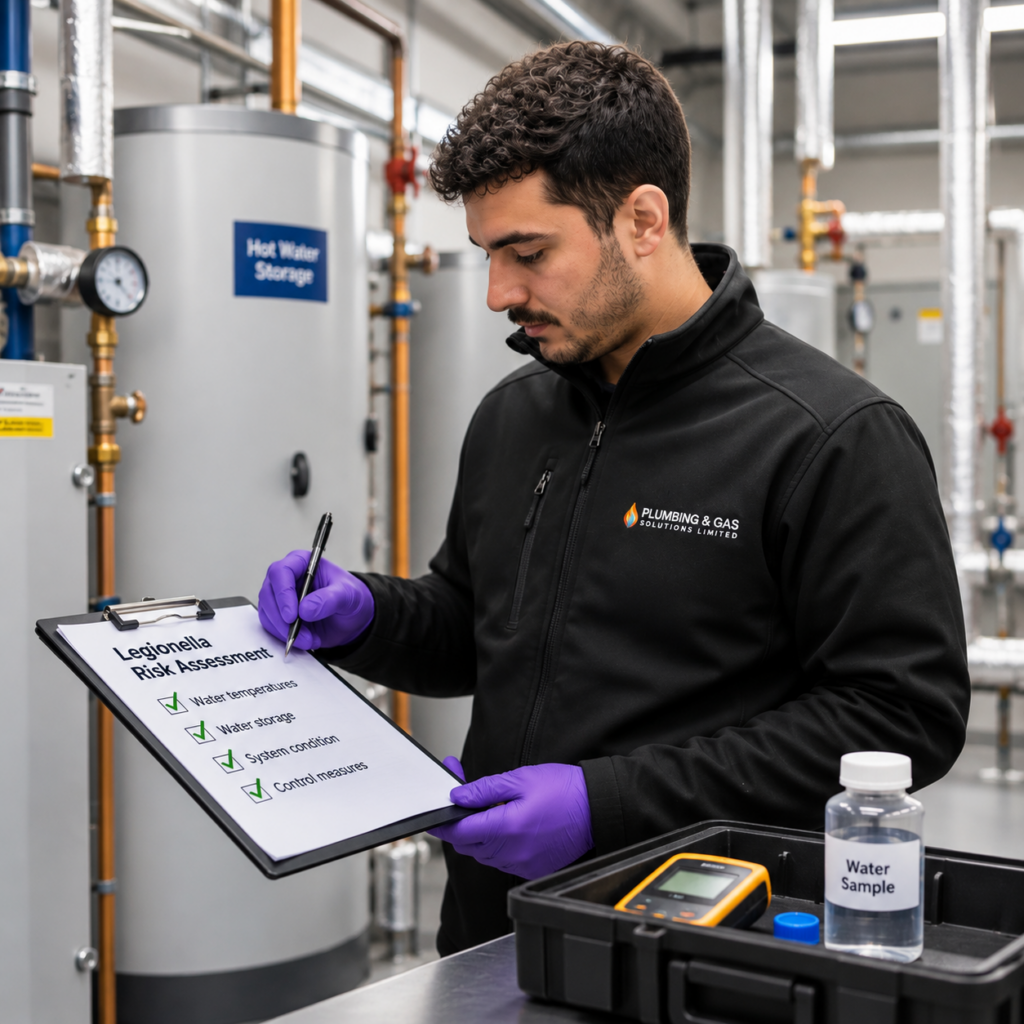
Meeting the requirement involves more than owning a document. The HSE’s page on what you must do boils it down to four things: identify and assess the risk, manage it, prevent or control it, and keep records.
In a typical office, school or multi-let building, the sources of risk are the hot and cold water systems: calorifiers (the hot water storage vessels), cold water tanks, showers, and little-used outlets where water sits still and warms up. ACoP L8 expects you to assess those risks, appoint a competent responsible person, write a control scheme, and keep records of what you do.
HSG274 Part 2 is the practical companion for hot and cold water systems. It is guidance rather than law, but it is what an inspector will measure you against: temperature checks, flushing routines, tank inspections and how often each should happen.
Who is the responsible person for legionella?
The responsible person is the individual the duty holder appoints to manage the control scheme day to day. The duty holder is usually the employer, business owner or landlord.
In practice the responsible person is often the office manager, school business manager or facilities lead, provided they have enough training and authority to do the job. You can delegate tasks such as temperature monitoring or sampling to a contractor, but you cannot delegate the legal duty itself. That is why the appointment should be recorded in writing, with the role, training and reporting lines defined. If nobody has been formally named, that is usually the first finding in any audit.

Six steps to manage legionella compliance
- Confirm your duty holder and responsible person. Put both appointments in writing and arrange basic legionella awareness training for the responsible person if they have not had any.
- Find your current risk assessment and check its date. If your water systems, occupancy or usage have changed since it was written, or you cannot find it, commission a new one from a competent assessor.
- Turn the findings into a written control scheme. It should cover temperature monitoring, flushing of little-used outlets, calorifier inspection and servicing of thermostatic mixing valves (TMVs), the valves that blend hot and cold water at the tap.
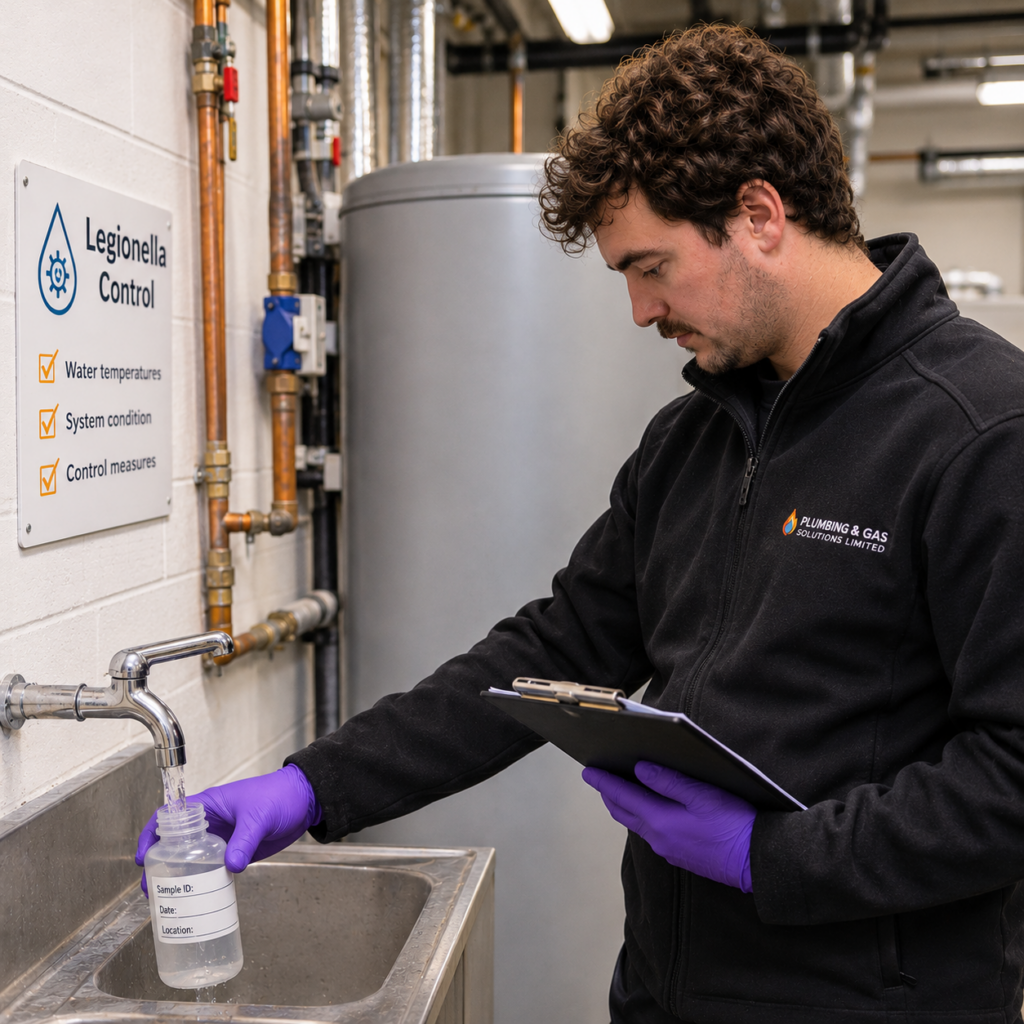
- Set up the monitoring routine. HSG274 Part 2 expects monthly temperature checks at sentinel outlets, the taps nearest and furthest from the water heater, with results recorded. Little-used outlets should be flushed weekly and the flushing logged.
- Sample where your scheme calls for it. Where the assessment or control scheme requires sampling, samples should be analysed by a laboratory accredited by the United Kingdom Accreditation Service (UKAS). Sampling supplements your controls; it never replaces them.
- Keep the records together and budget for the ongoing cost. Assessments, monitoring logs and remedial work records should be retained, with monitoring records kept for at least five years. Plan and budget for periodic reviews so compliance is ongoing rather than reactive.
A practical example: preparing for the Christmas shutdown
Before the Christmas break, check who is responsible for flushing little-used outlets and what checks your control scheme calls for before the building reopens.
This applies to offices, schools and other commercial premises that may have reduced occupancy or close temporarily. Your control scheme should set out who carries out any required flushing and monitoring during the closure, and what checks are needed before reopening. The same principles apply to other periods when outlets are little used.
Where PGS fits in
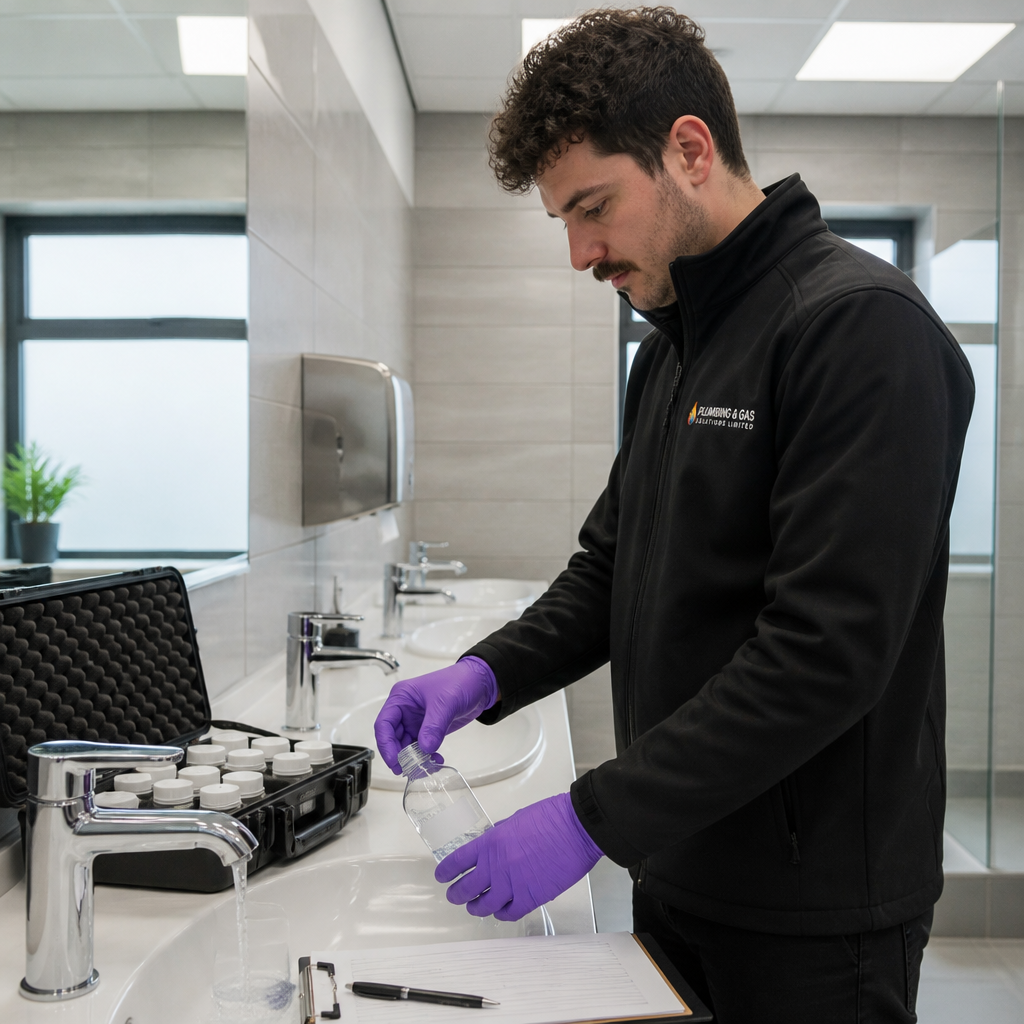
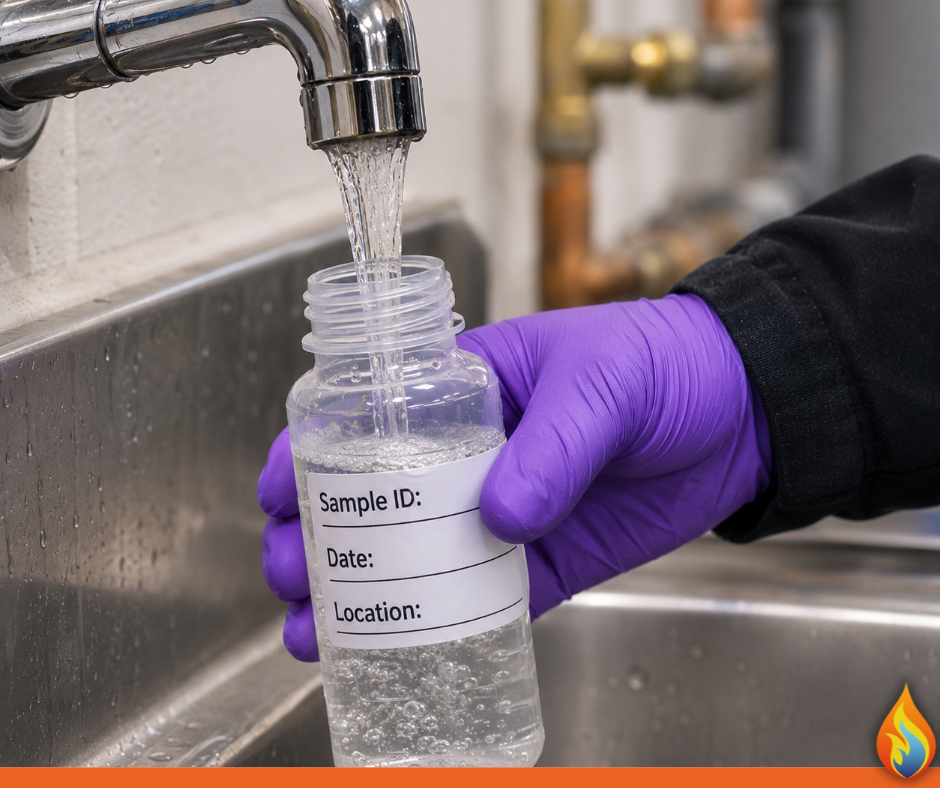
Plumbing & Gas Solutions provides legionella testing and sampling for commercial premises across Milton Keynes, Buckinghamshire, Bedfordshire and Northamptonshire. Our engineers take samples from the outlets your scheme identifies, using bottles supplied by a UKAS-accredited laboratory, and dispatch them to the lab the same day. You receive a certificate of results when the analysis is complete.
If the results, or your risk assessment, call for remedial plumbing work, we carry it out: removing dead legs, servicing or replacing TMVs, insulating pipework, and inspecting or replacing calorifiers and storage tanks. A dedicated project manager coordinates the whole job, so you have one point of contact from first visit to sign-off.
What to watch out for
- Treating the assessment as a one-off. An assessment from 2019 with no review since is unlikely to be judged suitable and sufficient.
- A certificate with nothing behind it. Inspectors want to see the control scheme and monitoring records, not just a cover page.
- Assuming small premises are exempt. Simple systems may need only a simple assessment, but the duty still applies.
- Sampling sold as a substitute for assessment. Testing has its place, but it does not replace the risk assessment or the control scheme. We will tell you that ourselves.
- Contractors who will not share their methodology or qualifications. If the paperwork is vague now, it will not survive scrutiny later.
Quick checklist
- Find your current legionella risk assessment and note the date it was carried out.
- Confirm the responsible person is named in writing and has had awareness training.
- Check that monthly temperature records exist for your sentinel outlets.
- Verify that little-used outlets are flushed weekly and the flushing is logged.
- Confirm calorifiers and TMVs have been inspected or serviced in the last 12 months.
- Check records are stored where an inspector could see them, not on a former employee’s laptop.
- Schedule periodic reviews and include ongoing legionella controls in your maintenance planning.
Frequently asked questions
How often does a legionella risk assessment need to be done?
There is no fixed legal expiry date. The HSE expects you to review the assessment regularly and whenever there is reason to believe it is no longer valid, for example after plumbing alterations, a change of use, or a positive legionella sample. Many organisations schedule a formal review every two years as a sensible benchmark, with ongoing monitoring in between.
Does legionella sampling have to be analysed by a UKAS-accredited lab?
Routine sampling is not required for every building. Where your control scheme calls for it, HSG274 recommends that samples are taken in line with BS 7592 and analysed by a UKAS-accredited laboratory, so the results carry weight with inspectors and insurers.
Do landlords legally need a legionella risk assessment?
Yes. The duty under COSHH and the Health and Safety at Work Act applies to residential landlords as well as commercial ones. For most straightforward domestic properties the assessment can be simple, and in low-risk cases a competent landlord can carry it out themselves. For houses in multiple occupation, blocks or properties with stored water, a professional assessment is strongly advisable.
What happens if I do not have a legionella risk assessment?
The HSE or your local authority can issue an improvement notice requiring you to put one in place, and prosecution is possible where risks have been ignored. Fines for health and safety offences are unlimited, and individual duty holders can be prosecuted personally in serious cases.
Can I do the legionella risk assessment myself?
Legally yes, if you are competent, meaning you understand water systems, legionella risks and the requirements of ACoP L8. In practice, most offices, schools and multi-let properties have systems complex enough that a trained assessor is the safer choice. If you self-assess and get it wrong, the responsibility still sits with you.
Conclusion
The duty exists, it sits with you, and the HSE’s expectations are written down in plain terms. What separates compliant duty holders from the rest is not the paperwork but the follow-through: a named responsible person, a control scheme that is actually run, and records that show it.
If your assessment is current and your monitoring is logged, you are in good shape. If either is missing, the six steps above will get you there, and the sooner you act, the easier it is to demonstrate ongoing compliance.
Need sampling or remedial work to support your control scheme? Visit our legionella testing page for a free quote, or call 01908 569031. We will arrange a visit at a time that suits your site, take the samples your scheme requires, and give you a clear certificate of results.